| |
By Barry Boyce, CyclingRevealed Historian
|
|
“New ideas! Bold Initiatives!”
“New ideas! Bold Initiatives!” were necessary to pull the Tour de France out of the "relentless rut of tedium". Desgrange took a bold step in 1930 by eliminating the trade team system and instituting the National team structure.
The change did not come without a monetary cost. The elimination of the trade teams meant the elimination of the commercial sponsorship money. Each team's expenses had to be paid by the race's long time organizer, L'Auto newspaper. Part of the change meant each rider would be outfitted with a “yellow colored” bicycle.
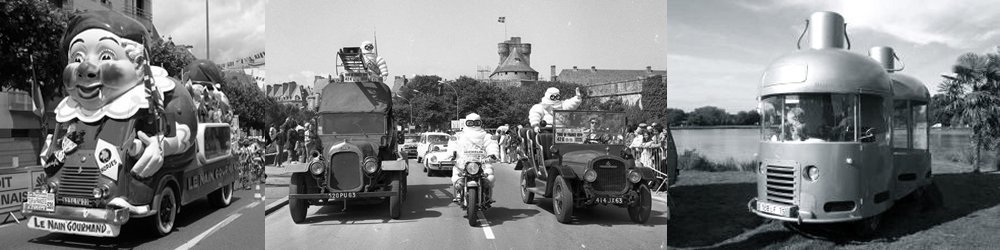
Needing additional revenue sources Desgrange, taking the advice of Pierre Thevenin (advertising manager of Menier Chocolates), came up with a masterstroke of advertising. He introduced the Tour's first “Caravane de Publicite” (publicity caravan). The publicity caravan tapped both the cycling industry, which had money to spend on advertising, and the non-cycling companies, who loved the opportunity to advertise with the popular Tour de France. For the advertising money invested in the Tour, the sponsor got the opportunity to show their products along the Tour's race route. The most popular sponsor in 1930 was Menier Chocolates. 500,000 cycling fans came early to their place along the route to get the chocolate handouts.
Caravane de Publicite
The national team format may have been a very necessary change, but it was revolutionary, untested concept. It took the exploits of a band of young French riders to make the Tour in 1930 a resounding success.
Andre Leducq won two stages and took full control of the race lead in the Pyrenees Mountains. Antonin Magne rode to a third place finish and a spot on the podium in Paris. Charles Pelissier, youngest of the famous Pelissier brother, won eight stages.
Although the French team easily won the race in Paris, it did not come without drama along the way. The powerful Italian team featured “Campionissimo” Alfredo Binda. In the early stages of the race the Italians controlled the race. Their efforts began to crumble on the 222 km stage 7, “individual team departure” race from Bordeaux to Hendaye. Team leader Alfredo Binda crashed heavily on Stage 7 and lost more than an hour. He dropped out of contention in the General Classification. Showing his pride and talent Binda roared back to win stages 8 and 9, but the pain of his injuries became too much and he sadly abandoned on stage 10.
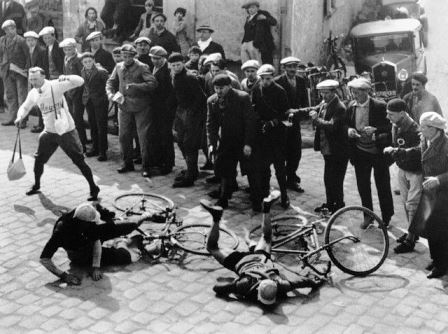
Binda crashing on stage 7
Binda's rampage on Stage 9 was answered easily by Andre Leducq as the French team took control of the race. Leducq put the race out of sight on Stage 14
and 15 gaining almost 13 minutes on his second placed teammate Antonin Magne. But the road to Paris was not easy for Leducq.
While riding the Stage 16 breakaway Leducq crashed heavily descending the Col du Galibier and lost consciousness. With help from his teammates he remounted and began a hard chase. The next climb was the Col du Telegraph and misfortune struck again. Leducq broke a pedal and crashed again. Dazed and in shock the race leader wanted to abandon. Again surrounded by teammates Leducq remounted and started a second chase.
There were still 60 km to the stage finish in Evian. Italian Learco Guerra held a 15 minute lead and was the “race leader on the road”. An inspired French team executed a brilliant chase and caught Guerra in Evian. Following his team’s lead-out Leducq took the stage win. The race was now over.
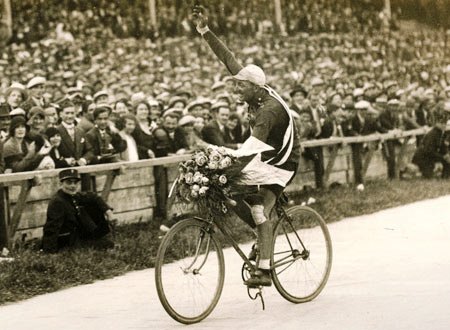
Andre Leducq
Andre Leducq rolled into Parc des Princes Velodrome in Paris victoriously. With Leducq's victory the French fans had excitement restored to their Tour.
SPECIAL NOTE: The National team format was clearly a success. The French were again rushing out to buy their daily L'Auto. Henri Desgrange had to be very pleased with the result achieved in 1930, but it remains unclear how he truly felt about the French teamwork. Individual heroism was abandoned and each French team member rode for team not individual. Regardless of how anyone felt, bottom line of the results, the Tour de France was back on track.
Stage and Distance |
Stage Winner |
Race Leader |
Stage 1 PARIS-CAEN, 206 km |
Charles Pelissier (Fra) |
Charles Pelissier (Fra) |
Stage 2 CAEN-DINAN, 203 km |
Learco Guerra (Ita) |
Guerra Learco (Ita) |
Stage 3 DINAN-BREST, 206 km |
Charles Pelissier (Fra) |
Guerra Learco (Ita) |
Stage 4 BREST-VANNES, 210 km |
Omer Taverne (Bel) |
Guerra Learco (Ita) |
Stage 5 VANNES-LES SABLES D'OLONNE, 202 km |
Andre Leducq (Fra) |
Guerra Learco (Ita) |
Stage 6 LES SABLES D'OLONNE-BORDEAUX, 285 km |
Jean Aerts (Bel) |
Guerra Learco (Ita) |
Stage 7 BORDEAUX-HENDAYE, 222 km |
Jules Merviel (Fra) |
Guerra Learco (Ita) |
Stage 8 HENDAYE-PAU, 146 km |
Alfredo Binda (Ita) |
Guerra Learco (Ita) |
Stage 9 PAU-LUCHON, 231 km |
Alfredo Binda (Ita) |
Andre Leducq (Fra) |
Stage 10 LUCHON-PERPIGNAN, 322 km |
Charles Pelissier (Fra) |
Andre Leducq (Fra) |
Stage 11 PERPIGNAN-MONTPELLIER, 164 km |
Charles Pelissier (Fra) |
Andre Leducq (Fra) |
Stage 12 MONTPELLIER-MARSEILLE, 209 km |
Antonin Magne (Fra) |
Andre Leducq (Fra) |
Stage 13 MARSEILLE-CANNES, 181 km |
Learco Guerra (Ita) |
Andre Leducq (Fra) |
Stage 14 CANNES-NICE, 132 km |
Louis Peglion (Fra) |
Andre Leducq (Fra) |
Stage 15 NICE-GRENOBLE, 333 km |
Learco Guerra (Ita) |
Andre Leducq (Fra) |
Stage 16 GRENOBLE-EVIAN, 331 km |
Andre Leducq (Fra) |
Andre Leducq (Fra) |
Stage 17 EVIAN-BELFORT, 282 km |
Frans Bonduel (Bel) |
Andre Leducq (Fra) |
Stage 18 BELFORT-METZ, 223 km |
Charles Pelissier (Fra) |
Andre Leducq (Fra) |
Stage 19 METZ-CHARLEVILLE, 159 km |
Charles Pelissier (Fra) |
Andre Leducq (Fra) |
Stage 20 CHARLEVILLE-MALO LES BAINS, 271 km |
Charles Pelissier (Fra) |
Andre Leducq (Fra) |
Stage 21 MALO LES BAINS-PARIS/Parc des Princes, 300 km |
Charles Pelissier (Fra) |
 Andre Leducq (Fra) Andre Leducq (Fra)
|
| TdF July 2-July 27, 1930 |
| 4,822 Km |
1.
Andre LEDUCQ (Fra) 172h12'16" |
2.
Learco Guerra (Ita) +14'13" |
3.
Antonin Magne (Fra) +16'03 " |
Starters: 100 |
Finishers: 59 |
Average Speed: 27.978 km/h |
TdF 1929
TdF 1931
Return to the Timeline ToC
Return to the Race Snippets ToC |
|


 24th Tour de France 1930